Top 20 Job Interview Questions (and Answers) for Remote Roles

A short summary
- Interviews for a work-from-home (wfh) role do not focus solely on your skills for the specific job (e.g., your technical abilities) and the culture fit, but also on your remote working fit; for example, your communication and time management skills, as well as your ability to work independently.
- This article shows how to best answer the 15 most common interview and wfh questions, as well as the 5 best questions to ask your interviewer.
- Great answers should demonstrate your relevant work experience, passion for the role, and cultural fit, while highlighting your ability to work comfortably remotely, including your proactivity and independence.
- Verdict: Passing remote job interviews is about demonstrating that you are a reliable, proactive, cultural add who can communicate effectively while working without direct and constant oversight.
Introduction
With more than a quarter of UK workers now following a hybrid setup (ONS, 2025), remote-first hiring standards are now far more defined than they once were.
Unlike traditional interviews, remote job interviews test more than just whether you can do the work. Employers also want to know whether you can maintain productivity independently, communicate clearly across digital tools and manage your time effectively with minimal oversight. Even experienced professionals can stumble here, not because they lack skill, but because remote interviews evaluate a slightly different set of strengths.
That is exactly what this guide is here for. I will walk you through the most common job interview questions for UK remote roles, along with practical answers that reflect what employers are actually looking for today. So instead of second-guessing yourself mid-interview, you can approach your next opportunity with more confidence and a better chance of securing your next work-from-home job in the UK.
Why should you listen to us?
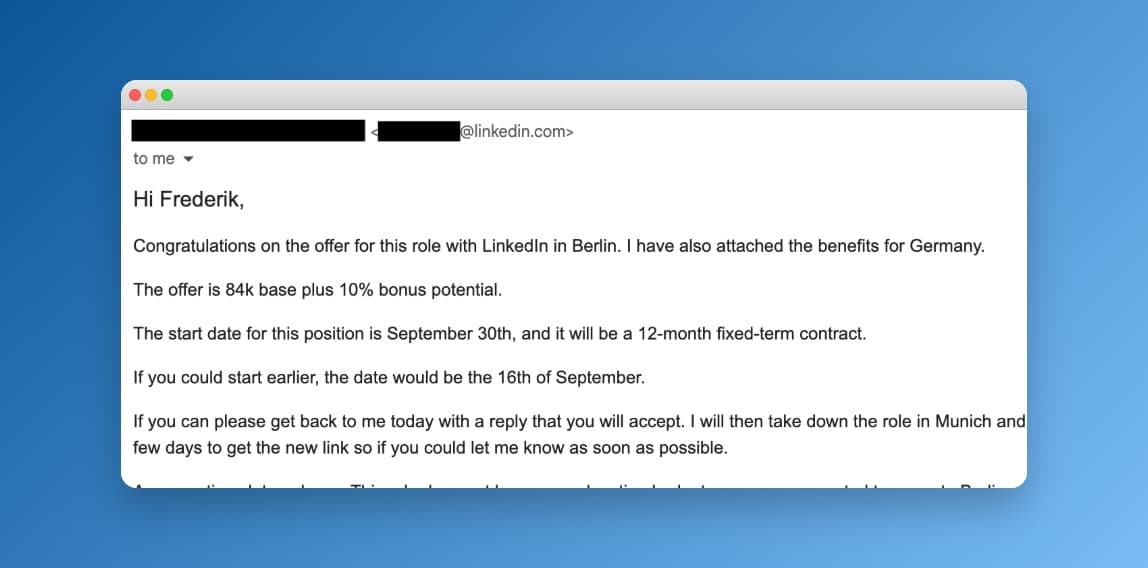
As you can see in the screenshot, this is the actual offer I received from LinkedIn; which I turned down. And yes: They wrote my name wrong. In other words, I have personally landed multiple wfh job offers from well-known companies such as LinkedIn and Microsoft, as well as from fast-growing AI startups and other startups that I found very interesting.
Also, in my current role as a consultant, I had to learn to master interviews to show potential clients that I am not only competent but also the perfect person (i.e. trusted advisor) to solve their pain points.
Hence, we at RemoteCorgi believe that I know a bit about mastering interview questions and getting the role you always wanted. That is exactly what this guide is here for.
The 10 Most Common Job Interview Questions (And How to Answer Them)
1. Tell me about yourself.

Nine times out of ten, this will be the opening question that sets the tone for the rest of your interview, and often the first hurdle that trips people up. You could go in different directions and still make sense, but the challenge is knowing which one actually lands. So how do you decide which direction to take?
First, understand that your interviewer is not asking for your life story. Rather, they are trying to see how efficiently you communicate and how your background connects to the role. Being able to understand your why. At the same time, they are assessing whether you understand the role well enough to position yourself as a strong fit.
Now, you could also talk about your hobbies, your interests, even your love for work memes, but it is best to steer away from that unless your interviewer hints at it. Hence, keep your answer focused.
Example answer:
"I'm currently working as a customer support specialist, where my day-to-day involves a high volume of email and live chat queries. Before this, I worked in retail, where I really sharpened my communication skills and learned to stay calm under pressure, especially when dealing with customer issues that can easily escalate if not handled well.
Doing this, I realised later that I enjoy roles where I can solve problems and have some room for personal creativity in how I approach them. Now, I'm looking to keep working remotely and be part of a team whose mission of make global change visible, accessible, and actionable deeply connects with my love for nature."
2. Why do you want to work here?

In some cases, interviewers also phrase this as 'What interests you about this role?' Either way, it serves to see whether your motivations align with what the company offers, and gauge whether you have actually looked into the company and the role beforehand, or are just applying blindly.
Therefore, a strong answer should combine three things: a mention of what the company does, what in particular stands out to you about them and how that connects to your experience or goals.
Example answer:
"I'm particularly interested in working for your company because of your focus on sustainability, and how it's not just something you talk about but something that shows in how your products are sourced and delivered.
That stood out to me because it reflects a genuine level of transparency and commitment, which is something I value in my own work as well, especially in dealing with customers and managing their expectations."
3. Why are you leaving your current job?
This question is as much about honesty as it is about how you frame your decisions. The interviewer is looking to understand your reasoning and attitude, and whether you take ownership of your career choices rather than blaming circumstances or other people.
When answering, do not go into unnecessary detail or speak negatively about your current employer. Instead, position your answer around growth or a change in goals or direction. I personally would always frame it about what makes your future employer unique and why it draws you in; instead of what pushes you away from your current employer.
Example answer:
"I've learned a lot in my current role, especially when it comes to handling day-to-day operations and working with a team under pressure. But over the past year, I've realised I'm more productive when I can work independently and manage my own time. That's what led me to apply for this remote role, where I see a lot of professional growth opportunities with interesting tasks and a great team."
4. What makes you the best candidate for the role?
Also sometimes phrased as 'Why should we hire you?', this question drills into the specific value you bring to the company. Therefore, your response should focus on these three things:
- Your biggest strength.
- How you can use that strength to solve a specific need in the role (you can pick this up from the job description).
- A specific example of how you delivered on those needs with quantifiable improvements.
For instance, if it is a leadership or management role, you will want to highlight qualities that make you a strong leader and show quantified evidence on how you have improved the organisation in the past. This way, your interviewer also understands your leadership style and whether it aligns with how the organisation operates.
Example answer:
"One of the main reasons I'd be a strong fit for this role is my ability to stay organised and proactive in a remote environment. In my current role, I manage multiple projects at once without direct supervision, and I've also gone the extra mile to develop SOPs to address bottlenecks and support new team members.
At one point, we started seeing compounding delays in task handovers. So, I created a simple workflow and documentation system that clarified responsibilities and reduced back-and-forth. Since then, turnaround times have improved by 40% and the onboarding process has become much smoother for new hires."
5. Can you tell me about a time you overcame a difficult situation at work?

This is a common behavioural question interviewers use to distil how you handled challenging situations at work in the past. It could be anything from a disagreement between team members to how you dealt with a mistake.
That matters even more in remote work environments, where the absence of nonverbal cues can easily lead to misinterpretation and escalate relatively minor issues into more serious conflict. That is hardly surprising given that nonverbal communication is often cited to account for more than 90% of how we understand each other (Radford et al., 2025).
As such, you must demonstrate how well you think under pressure, your initiative to take responsibility rather than avoid it, and, to some degree, your creativity when it comes to solving problems.
A common mistake to avoid: do not try to sound perfect. Interviewers are not expecting flawless situations. They are looking at how you respond when things do not go as planned.
Example answer:
"There was a time when team members disagreed on how to handle a client request, and it started to delay our response time.
In situations like this, I go back to a simple principle: what's the north star? The main objective? In this case, it was resolving the client's issue as quickly as possible. I suggested that we align on that priority first, then divide the tasks based on each person's strengths.
As a result, we were able to respond to the client on time. It wasn't a perfect solution by any means, but the silver lining was that it also opened up the opportunity for the team to recognise that these kinds of bottlenecks can happen and to start developing a clearer approach for handling similar situations moving forward."
6. What is your greatest weakness?
This question can be a bit tricky and I personally dislike it, as it can turn a job interview into more theatre as it already is. However, the reality is that it's a test of your self-awareness, especially when it comes to your own limitations.
You do not want to give an answer that raises red flags for the role but you also should not give a disguised strength (e.g. 'I am a perfectionist' or 'I care too much about my work')
Interviewers already know no candidate is perfect. The key is to choose a real, honest weakness and clearly explain what you have done (or are doing), to keep it under control and prevent it from affecting your work.
Example answer:
"One area I've been working on is my tendency to say 'yes' to everything. I always want to be helpful, but it can sometimes lead to me taking on more than I can realistically handle.
So I started setting clearer priorities and assessing my workload and timelines before committing to anything. If needed, I communicate early so the team can recalibrate, rather than rushing things at the last minute."
7. How do you see yourself X years from now?

It could be three, five or ten years from now, but regardless, this question is all about direction. The interviewer is trying to get a sense of whether you're working towards something or simply looking for a job.
At the same time, companies are not just hiring for the short term. They bring on board people who can grow with them, and this gives them a feel for whether what you are aiming for lines up with what they can offer, and whether you are likely to stay engaged in the long run.
You do not need a perfectly mapped-out plan, but you should be able to describe the kind of work you want to grow into, the skills you want to build and how the role fits into that path.
Example answer:
"In the next three to five years, I see myself growing into a more senior position where I can take on greater responsibility, particularly in leading projects and improving team processes. This role gives me the chance to expand my skill set across different areas while continuing to sharpen the strengths I already have."
8. What are your salary expectations?
Just as we are limited by what is in our own wallets, companies also have a budget they need to stick to. This question helps them quickly gauge whether your expectations fall within that range and whether there is a realistic chance of moving forward.
Now, while some companies genuinely pay for value, others will aim for the lowest they can get away with. Negotiate your salary if you can, but always come in with research based on UK salary benchmarks for similar roles.
Example answer:
"Based on my research and the responsibilities of this role, I'd expect something in the range of £35,000 to £42,000. I'm open to discussing this further depending on the overall package, including benefits and growth opportunities."
9. How do you handle stress?
Interviewers want to know how you respond when pressure builds, especially in a remote setup where no one can see you struggling in real time. They want to feel confident that you can stay reliable and productive without things slipping and affecting the rest of the team.
So assure them. Do not just say you can handle stress. Demonstrate that you have a sustainable way of managing it. Instead of saying you 'just push through', talk about how you prioritise tasks, take short 5-minute breaks to reset or communicate early when workloads start to build up.
Example answer:
"I tend to feel the most stress during periods where multiple deadlines overlap. I handle it by restructuring my tasks and laying them out visually, which immediately takes some pressure off as I can see the bigger picture more clearly.
From there, I assess what I can realistically complete and identify anything that might become a problem. I then communicate early with the team if I need support or if priorities need to be adjusted."
10. What is your biggest win?
Every organisation wants a winner, someone who can deliver real outcomes (not just effort) and proudly say, 'I made that happen'. So, your goal here is to highlight a result that had real impact, while also showing you can take ownership and see things through to completion.
Example answer:
"One of my biggest wins was helping improve our team's response time to customer queries. At one point, we started falling behind as the volume picked up, and it was starting to affect customer satisfaction.
I took the initiative to review our workflow and introduced a simple tagging and prioritisation system. Within a few weeks, response times improved dramatically and we started seeing fewer follow-up complaints."
5 Work From Home Job Interview Questions and Answers
1. Have you worked remotely in the past?

Working from home is a different battlefield, where many of the communication barriers and challenges that didn't matter as much in a standard office setup become more pronounced and critical.
That is to say remote work changes how teams communicate. Researchers have shown that remote work increases asynchronous communication, which can make collaboration and information-sharing more difficult without proactive communication habits in place (Yang et al., 2022).
As such, your interviewer will want to know if you have a track record of collaborating and working effectively without constant supervision in a remote environment.
If yes, you are already in a good position. You can simply circle back to your CV and walk them through the tools you have used and how you used them to stay aligned with your team.
If not, no worries. That does not mean you are out of the running. However, you do need to prove that you can be accountable, proactive and reliable in a remote setup. At the end of the day, all the company wants is assurance and peace of mind that they are investing in someone they can trust to deliver without constant supervision.
Example answer (with remote experience):
"Yes, I've been working remotely for the past two years. In that time, I've used tools like Slack and Zoom for day-to-day communication, and project tools like Trello to keep tasks visible and on track."
Example answer (no remote experience):
"I haven't worked in a fully remote role yet, but in my current job, I regularly work independently and manage my own tasks without much supervision. I also rely heavily on digital tools to stay organised and communicate with my team, which I'd say translates well into a remote setup."
2. How do you switch off from work?
One downside of working from home is how easily work can bleed into your personal time, which, without clear boundaries in place, can eventually lead to burnout. In fact, a review published by Hall et al. (2024) found that home-based workers reported working longer periods without breaks.
So in essence, this question is really about how you manage that boundary and maintain a healthy work-life balance instead of slipping into work-life conflict.
Let the interviewer see that you have clear, intentional habits that help you switch off. This could be a defined end-of-day routine, a dedicated workspace, time blocks, or any small rituals you follow that signal to your brain that the workday is done.
Example answer:
"I have the privilege of having a dedicated workspace at home that's physically separate from my bedroom and living room. I don't step into it again until the next workday, which, in a sense, helps me focus on my personal life and fully switch off. It allows me to 'forget' about work until the next day instead of carrying it in my head after hours."
3. How do you handle deadlines?
Missing deadlines not only delays work. It can also mean missed opportunities or even lost revenue for the company. How do you make sure things stay on track and nothing falls through the cracks?
Show how you manage deadlines, not just that you can meet them. Talk about how you plan ahead, prioritise tasks, communicate early and take ownership.
Example answer:
"I keep a simple running to-do list with my own 'internal' deadlines ahead of the actual ones. That gives me real buffer time in case anything unexpected pops up or if I need to wait on others team members."
4. How do you handle distractions at home?
Working from home keeps you away from typical office distractions like constant office chatter and unnecessary meetings, but it introduces you to new ones: the temptation of your couch, your overly affectionate pet or even family members dropping in.
This is not just a personal productivity issue either. Research has shown that the lack of separation between family life and work from home can increase stress and conflict within households (Yang et al., 2022).
So how do you manage that and still make sure your work is delivered on time and to the expected quality? Your response should touch on your work setup, your routine and how those choices actually reduce distractions and help you stay focused.
Example answer:
"One of the biggest distractions for me used to be constant message pings. I'd find myself checking them right away and losing focus. What I started doing instead was setting specific check-in times for messages and blocking out time for deep work."
5. Can you explain why you changed career paths?
Many traditional roles are not designed to be remote-friendly, so transitioning from an on-site role to a work-from-home job can mean stepping into a slightly different career path altogether, which may raise eyebrows.
The key is to show that your decision is intentional. You should be able to connect the dots between your previous experience and the new role, and show that your skills are transferable, so the value you bring is clear from the start.
Example answer:
"I started out in retail, where I spent a lot of time dealing directly with customers and handling day-to-day issues. Over time, I realised I enjoyed the problem-solving side of the role more than the face-to-face aspect. That's what led me to move into customer support, where I could use those same skills in a more structured and scalable way."
Reverse Interviewing: The Best 5 Questions to Ask in a Job Interview

When you are in the last few minutes of your interview and they ask, 'Do you have any questions for me?', never say 'I don't', or you will miss out on a chance to reinforce your value and improve your odds. At the same time, it helps you figure out whether the opportunity is worth your time and showcase that you came prepared to the job interview.
1. What stood out to you most about my CV?
This question prompts the interviewer to revisit why they shortlisted you in the first place. It gives them a chance to highlight your strengths, which subtly reinforces your case for moving to the next round.
2. Say I get hired, what would I have accomplished in the next 3 months that would make me a successful hire?
A strong follow-up that builds on the previous question is to get the interviewer to imagine you in the role and describe what you would have done to be considered successful. This mental exercise can create a subtle positive bias, while also giving you a clear view of their priorities, key projects and other aspects that matter most to them.
3. Is this a new role or will I be taking over someone who is leaving?
If it is a new role, it usually means they are adding a new dimension to the team. This often comes with the expectation that you will be helping them shape processes and smooth things out as you go.
If you are replacing someone, it gives you a chance to dig a bit deeper and ask why they left. That can give you useful context around the role, the team and what may or may not have worked before.
4. Do you expect the main responsibilities for this position to change in the next six months to a year?
This will help you gauge how clearly defined the role is. A vague or constantly shifting answer could indicate a lack of planning or unstable priorities around the role, which can be risky from a job security standpoint.
5. Are there opportunities for advancement within the company?
You can take it a step further by asking for examples of how previous employees in this role have progressed.
References
Hall, C.E., Brooks, S.K., Mills, F., Greenberg, N. and Weston, D., 2024. Experiences of working from home: umbrella review. Journal of Occupational Health, 66(1), p.uiad013.
Office for National Statistics. "Who Has Access to Hybrid Work in Great Britain?" Ons.gov.uk, Office for National Statistics, 10 June 2025
ONS (2025) Who has access to hybrid work in Great Britain?, Who has access to hybrid work in Great Britain? - Office for National Statistics.
Radford, H., Reidinger, B., Kapp, S.K. and de Marchena, A., 2025. "There is just too much going on there": Nonverbal communication experiences of autistic adults. PloS one, 20(7), p.e0325465.
Yang, L., Holtz, D., Jaffe, S., Suri, S., Sinha, S., Weston, J., Joyce, C., Shah, N., Sherman, K., Hecht, B. and Teevan, J., 2022. The effects of remote work on collaboration among information workers. Nature human behaviour, 6(1), pp.43-54.