Top Jobs where You Can Work From Home in the UK

The shift toward remote work in the UK has accelerated rapidly since COVID, changing what employees expect and how companies can attract top talent. In 2025, the ONS reported that 28% of UK employees worked in a hybrid setup, which is four times higher than in 2019. More than 75% of workers reported that working from home (or short WFH) improved their work-life balance, with over 45% saying their well-being improved and 50% noting better focus (ONS, 2025). Personally, WFH has been vital for managing my cystic fibrosis, and many of my colleagues rely on remote work to care for their children. In this sense, remote and hybrid work have become major benefits that companies now use to attract talent.
This article will guide you through finding work-from-home roles in the UK. We cover what WFH means, which jobs best fit remote models, and highlight leading companies that offer such opportunities. We regularly update this resource, so check back for new information and feel free to share it.
What is a Work From Home Job?

Many terms describe this work: 'online jobs,' 'remote work,' and 'work from home', or short 'WFH'. 'Remote work' refers to working from various locations (primarily in specific countries), while 'work from home' means working from your own home address (Loi and Baid, 2025). We personally like the term WFH because it accurately describes the most common type of remote work: working from home. In WFH jobs, company policies may require you to be within a particular region or near the office for occasional in-person tasks. While some roles are fully remote, there are times when visiting the office is necessary, such as for equipment or meetings. Read more about the benefits and negatives of working from home.
The Rise of Hybrid vs. Fully Remote Roles in 2026
For some businesses and employees, fully remote roles may be too extreme, so we believe hybrid options are a smart choice. Hybrid work gives employees the flexibility to work from home or the office, manage family or personal obligations, and allows businesses to lower real estate costs by having fewer employees in the office while maintaining office culture.
Best Work-From-Home Roles in the UK

According to ONS (2025), only a quarter of jobs are hybrid or remote. These flexible roles are usually found in higher-skilled work that requires higher qualifications (ONS, 2025).
In this section, we will review all the top job categories suitable for WFH, providing an overview for each category. Let's get started:
Engineering
One of the most popular and well-paid WFH jobs are engineering roles, especially software engineer. Engineering is an extremely broad field, ranging from electrical, mechanical, and chemical engineering to civil engineering. Minami has worked as software engineers and therefore we believe software engineers offer one of the best WFH opportunities and a solid salary. According to our research, the average annual salary for a software engineer in the UK is around 55'000 pounds.
As you work only on the computer, you will have little interaction or (hopefully) as few meetings as possible. Usually, you have a quick standup meeting in the morning, where you state what you will work on and maybe have a pair programming session. Depending on how the organisation works, they can also include sprint plannings, reviews and sprint retros.
In case you want to learn more about how you can become a software engineer, read our career path.
See the open work-from-home Engineering opportunities at RemoteCorgi.
Marketing
I worked in Marketing roles and I loved this versatile, at times very creative, role. Whether you are a social media manager, an SEO expert or more focused on Product Marketing, there are tons of Marketing roles that offer WFH. And by reading this blog article means we are doing at least a bit of Marketing right 😉.
We have written an in-depth career guide if you are interested in switching to this role. Also, if you are interested in how much a Marketing person in the UK earns, feel free to check out our salary page.
Also, see open WFH Marketing opportunities with us.
Sales
Sales is a very broad category, and there are many different types of sales jobs; you can even argue that consulting can be part of sales. We believe in especially in tech sales there are many roles you can do completely remotely.
Yes, there are cases when you have to go to the customer in person and where this is expected. Yet, we still believe that sales is a great career and actually pays well. And if you are eager to progress, eager to to listen to your customers, hear their pain points, and try to solve their issues with your organisations solutions, then you will be able to be a very successful salesperson who actually makes great commissions. As it can be mentally draining and stressful at times, it is not a career for everyone, but if you are willing to get up in the morning and make a commission in full swing, then this is a great role where you can progress quickly.
Read more on how you can get started in sales the best way and how much a business development manager can make.
Also, see our remote open sales job openings at RemoteCorgi.
HR

Human resources are an integral part of any business and organisation worldwide. An HR professional makes sure their organisation can attract new great talent and retain them while also adhering to all applicable UK work regulations. HR roles are a vital part for any organisation, and the great thing is that if you like to explore many different roles or sectors, you are in a very interesting position, since you can work from big corporates to small startups alike and even be industry agnostic. There are also plenty of work-from-home options for these 'people' officers, since basically all tasks, if not most of the tasks, can be done from home.
Read more on how you can get started in HR the best way and how much an HR Manager earns in the UK.
Also, see our remote open HR job openings at RemoteCorgi.
Design
This role is probably the most creative one on this list, and unfortunately, also one of the lower-paid. However, as it is a very creative, broad job, you have many opportunities. So you can work, for example, as a graphic designer, where every product and every company will need to convey a memorable story.
In this way, you are solving problems visually. Other than that, we are big fans of designers in the tech industry, especially UX (short for User Experience) and UI (short for User Interface) designers, who design the entire logical workflow as UX designers and the actual screen as UI designers. In our opinion, this is an extremely powerful position, since in many companies millions of people use your software, so you will have a huge impact with your research, such as interacting with customers to understand how they view the software and what issues they face. It can be a very fulfilling job that you can do completely remotely from home.
Read more on how you can become a graphic designer and see how much money you can earn as a graphic designer.
See our latest Designer WFH job openings.
Product
Product Managers, also known at times as the 'CEO of Product' (especially at Netflix), are extremely vital for developing products and driving innovation in any organisation. These people usually do market research, talk to a lot of users, and see with validated data what kind of new feature (for example) a software needs to progress in the long term, while at the same time being able to translate what the users want into clear technical descriptions that software engineers also understand.
In this sense, they are the bridge between the very technical software teams and the normal day-to-day user who needs to use your software. There are also other product managers, such as for more hardware or chemical products, but jobs in more remote-friendly roles are usually in the tech sector. We are big fans of this role, and I have worked in a similar role for a couple of years, which I absolutely loved.
It is one of my favourite roles because the organisation has a great deal of trust in you, as you research, think, and make big decisions that help the organisation go further and, in the end, solve problems better for users than it did before.
Customer Success
I used to work at one of the fastest-growing software startups in Europe, a fleet management company, as the Customer Success Manager. Customer success is a role you can do almost entirely remotely. Sometimes the customers want to meet you, but that is very rare, maybe once a quarter or so. But aside from that, you can usually do your work completely remotely.
The great thing about customer success is that, with the right metrics, you can look at your users, see how they use your software or your product, and quickly and proactively find ways to enhance their user experience. And that is also the main difference between customer success and customer service: Customer Success is a proactive function, whereas Customer Service is reactive. You can be proactive in finding ways to help them better use your product, which is, in a way, which I often view very similar to an in-house consultant advising on best practices of the software. Customer success is especially popular in the business-to-business (or short B2B) software industry, but also in other industries, such as aerospace.
Read our career path for Customer Success and see how much a Customer Success Manager can earn in the UK.
Browse also open Customer Success Roles hiring WFH right now.
Finance
Similar to HR, the finance role is very interesting for anybody who wants to work in an industry-agnostic field. That means you can work from non-profits to purely finance companies; basically, in any organisation and anywhere. And with it comes also a wide variety of roles, such as accountants, financial analysts, creating very complicated Excel spreadsheets, or even going into data science.
Finance is a very rewarding field and, of course, well-paid. And in terms of working from home, it gives you great opportunities with working from home jobs or remote jobs, since most of the tasks you will do is on a computer. Yet at times you need to go to the office, since there are some legal procedures or highly sensitive data that you might not be allowed to handle from home, depending on the size of the company.
Read our career path for becoming an accountant and see how much an accountant can earn in the UK.
Browse also open WFH Finance Jobs.
Operations
Working in operations is very rewarding if you love getting things done. As with almost any organisation, a lot is always going on in its day-to-day business. And as an operations manager or in any operations role, you need to ensure everything runs like a well-oiled machine. This is why operations can be a very rewarding role, where you can interact with many different people, but it is a bit harder to work from home completely. These are usually hybrid roles in operations, and as it is, you sometimes have to do on-site work. Yet, if you do not mind this too much and like to get some action in your daily life, and have a pivotal role in a company's operations, working in operations is very rewarding.
Read our career path for becoming an Operations Manager and see how much an Operations Manager can earn in the UK.
Browse also open WFH Operations Manager Roles in the UK.
Data Science

Data science is one of the fastest-growing job roles in the UK, and from the outside can seem very numbers-driven. It is true that you will probably spend most of your time programming (likely Python), finding the right metrics and producing reliable data that people can trust. This is a role where you do not need to interact with many people, as your main goal will be to build powerful dashboards for internal or external users to answer questions with data correctly. The overall goal is to increase transparency within organisations, especially in larger ones. So, a data science or data analyst role is often hired in larger organisations, offers great opportunities to work with AI, is well paid, and is usually completely remote.
Read our career path for becoming a data analyst and see how much a data analyst can earn in the UK.
Browse also open WFH Data Analyst Roles in the UK.
Cyber Security
Cybersecurity might seem a bit more of a niche industry, but since I am working in it right now and love it very much, I wanted to include it in this blog post as well. Cybersecurity is about protecting yourself against anyone who seeks to harm you, whether intentionally or by accident. There are many different actors that can attack you, from nation states to even young individuals, and your goal is to make sure that the organisation that you work for, such as a for-profit company, a nonprofit company, or even big government organisations, is protected from bad actors. That is why it is a role that is very fulfilling, rapidly growing, and can actually have a major positive impact on many people, even if they will never know it.
Read our career path for becoming a cyber security professional and see how much a cyber security professional can earn in the UK.
Browse also open WFH Cyber Security Roles.
Management
Management is, of course, more for senior or seasoned professionals, where you will manage many different kinds of people and need to deliver certain things. And of course, these roles can be work-from-home at times. The problem is that, sometimes, depending on the company, they expect more senior roles to be in person, rather than at home. But of course, the roles we include on our list often involve work from home, either purely remote or hybrid. Having said that, manager roles are the best-paid on this list and carry the most responsibility. But at the same time, the drawback is that you might not be able to work from home so often.
Read our career path for becoming a Project Manager and see how much a Project Manager can earn in the UK.
Browse also open WFH Management jobs.
Admin
Administrative roles can be in any area, such as payroll management or executive assistance, and are often found in larger organisations with more administrative tasks. It is a very vital role for most organisations, and there are quite a few work-from-home opportunities for that as well. It is similar to the design jobs from the pay perspective, since it tends to be more on the lower end; however, you often have more work flexibility, as they offer you more part-time and working from home options.
Read how you can become an Executive Assistant and see how much you can earn as an executive assistant.
Also, feel free to check out our open admin jobs.
Where to Find WFH Jobs?

In the UK, we believe there aren't many ways to find top work-from-home jobs. Of course, you can go to LinkedIn, the UK government or Indeed to find some working-from-home options in a subcategory, but it is rather cumbersome to find opportunities there. We personally quite like Flexa Careers or Welcome to the Jungle for finding work-from-home opportunities, but they all miss the same thing: high-quality curation delivered for free to your inbox.
We believe our hand-picked curated role for trusted top work-from-home jobs is one of the best options in the UK right now. Feel free to look at our entire work-from-home job board. If you have any suggestions or feedback, feel free to reach out to us at any time; we will always be happy to help.
What are the best companies to work remotely for in 2026?
We have a curated list of top remote companies to work for in the UK, and we will also write a more in-depth blog article about this very soon. We believe that our curated company profiles provide you with in-depth information so you can quickly understand how a company culture works, its benefits, your career growth opportunities, and whether it is a fit for you. There, we put a lot of emphasis on transparency and believe that any great company on our list could be a great match.
Our personal best tips on working from home

Despite being big believers in WFH and strongly recognising the importance of some employees (such as parents, personal caretakers, or risk groups), there are personal best tips to improve your experience working from home. These are our personal best tips to improve your experience working remotely:
- Before you start, make sure working from home is really what you want. Start to look at our top blog posts to see the pros and cons of remote work. Of course, you don't have commuting, you have no office drama or usually no direct office drama, but of course, the contrast can include loneliness, limited socialisation, overworking, or even underworking, and remote work is not really for everyone. And even if you decide to work from home, ask yourself what this should look like. Do you strictly want a work, strictly remote work, or strictly work from anywhere, or do you want to have more of a hybrid option? Do you want more flexibility? Do you just want to be there more for your family, or do you want more work-life balance? These are all questions you need to ask yourself first before going to the next thing, but out of our own experience, we are big advocates, of course, and believe that the benefits outweigh the negatives by tenfold.
- Have a dedicated workspace at home. Make sure you have a quiet room with minimal distractions where you can focus on your work. From experience, when we separate the room for work and the one for relaxation, like using your bedroom for relaxation and your office for work, you can separate work from free time much better.
- Make sure your internet connection is stable and that you have one of the fastest available in your region in the UK. The most frustrating part of working from home is when a video lags or you can't hear someone well during a meeting, which is why we always recommend having a strong, high-speed internet connection. You can also test your internet speed with our internet speed tester to make sure that your work is satisfying.
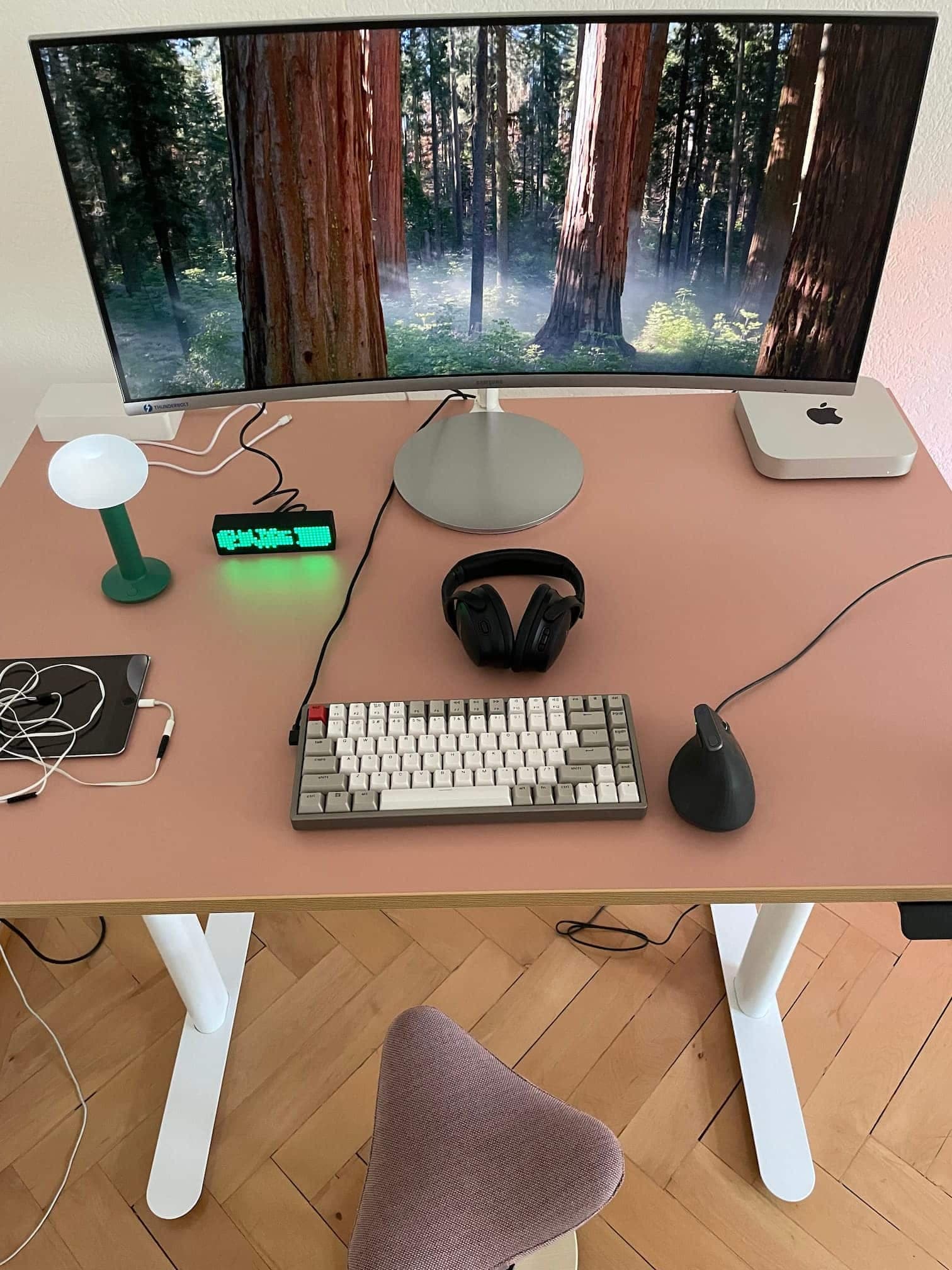
- Make your desk more ergonomic. We are personally big fans of the "Logitech MX Vertical Ergonomic Mouse", electric standing desks, an external computer screen and a comfortable ergonomic chair. See how we set up our desk in the picture below. You can also find many of these things with a small budget, especially when buying second-hand.
- Follow a daily routine: wake up, start work, have lunch, and finish up at the same time each day. This helps you to have a clear structure.
- When I feel overwhelmed by work, I also separate my work goals for the day into very small, manageable subtasks and write them on paper. Like "Write Email to Francine" and cut through it, once I am done. In this way, I try to keep focus on what truly moves the needle and have many small wins in a day.
- Out of personal experience, working from home can sometimes be draining or demotivating. Having days when you do not want to do anything and just want to watch videos or go out. At these times, it is good to switch it up sometimes and might go to the office once a week or find ways to get out of this feeling and motivate yourself again. I personally go to the office once a week, usually on Wednesday, so I feel motivated to work from home again and go for a walk on every lunch break, as it can feel overwhelming sometimes to be completely at home.
- WFH is not for everyone. It is most suitable for self-organised, very independent personalities. So we believe it is very important to stay self-organised, to have clear organisational skills, so you're always on top of everything you're doing, which is why self-organisation is so important. At the same time, as you want to work from home, you strive to be a bit independent, avoid too much micromanagement, and take proactive initiatives when required, right? At the same time, if that organisation can truly trust you, they often want to see some sort of more experience, like one to five years of work experience, where you can really shine in such an independent environment, such as your home.
Frequently Asked Questions (FAQ)
What jobs can I do from home?
The most common work-from-home jobs in the UK are, of course, working at the computer, office jobs, especially in tech companies such as startups or bigger corporates. These roles can include software engineering, marketing, sales, or management.
Do I need a specific degree for WFH jobs in 2026?
It depends. There are many work-from-home jobs in the UK; however, if you want a decent salary and, as we are focused on higher-quality jobs, we believe that having a specific undergraduate degree definitely helps or is required in many cases. If you work as a software engineer or even in a sales position at a smaller company or startup, you might not always need a degree. However, in larger organisations, this is quite common.
Are work-from-home jobs in the UK usually full-time, part-time, or freelance?
There are many types of work-from-home jobs, but the ones we list on our Remote Corgi are either full-time or part-time. We believe freelance positions are often not aligned with our values at RemoteCorgi, so we don't list them on our website. Yep.
Final Thoughts
Working from home in the UK has never been more achievable. Whether you are looking for a fully remote role or a hybrid setup, there are more opportunities than ever across a wide range of industries. Explore our latest fully remote job listings to find your perfect work from home role.
We hope this guide helped you navigate the world of WFH jobs in the UK — feel free to send us feedback anytime.
Resources
Office for National Statistics. "Who Has Access to Hybrid Work in Great Britain?" Ons.gov.uk, Office for National Statistics, 10 June 2025
ONS. "Is Hybrid Working Here to Stay?" Office for National Statistics, 23 May 2022.
Niebuhr, F., Borle, P., Börner-Zobel, F. and Voelter-Mahlknecht, S., 2022. Healthy and happy working from home? Effects of working from home on employee health and job satisfaction. International journal of environmental research and public health, 19(3), p.1122.
Kniffin, K.M., Narayanan, J., Anseel, F., Antonakis, J., Ashford, S.P., Bakker, A.B., Bamberger, P., Bapuji, H., Bhave, D.P., Choi, V.K. and Creary, S.J., 2021. COVID-19 and the workplace: Implications, issues, and insights for future research and action. American psychologist, 76(1), p.63.
Loi, T.I. and Baid, C., 2025. Shifting Grounds: Benefits and Drawbacks of Working from Home and Work Location Variability. In Academy of Management Proceedings (Vol. 2025, No. 1, p. 15417). Valhalla, NY 10595: Academy of Management.
Cho, E., Meier, L.L., Dormann, C. and Allen, T.D., 2025. Toward a dynamic understanding of work–family boundary management: A control theory perspective. Journal of Occupational Health Psychology, 30(2), p.63.
Junker, N.M., Heimrich, J., Häusser, J.A. and Rigotti, T., 2025. The relevance of work-related rumination and boundary control for spillover effects from work to home: results from a diary study. Work & Stress, pp.1-22.
ONS. "Family Spending in the UK." Ons.gov.uk, Office for National Statistics, 9 Sept. 2025.
"How Much Does It Cost to Start a Business?" Xero, 2024.
CIPD. "CIPD | Flexible and Hybrid Working Practices in 2023." CIPD, 15 July 2025.
Centre for Cities. "The Impact of Hybrid Working on the High Street." Centre for Cities, 28 Mar. 2025.